Osaka north · Minoh hillsNo.388★★Open in map →
Katsuo-ji
— a mountain temple colonised by tiny daruma
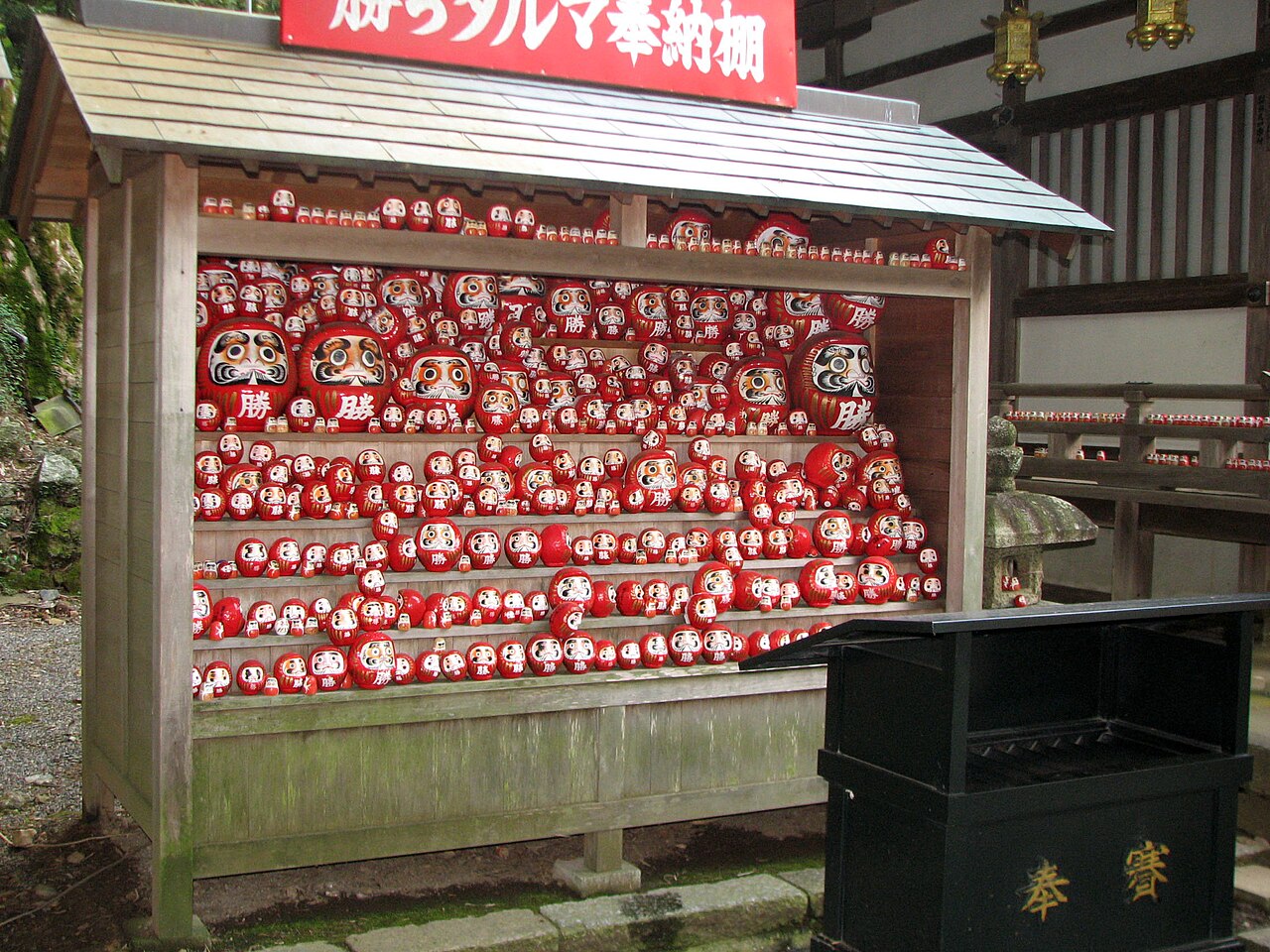
A Saigoku pilgrimage temple in the Minoh hills north of Osaka, where thousands of returned 'winning daruma' have accumulated across the grounds.
- FromOsaka / Umeda Stn
- ~60 minMetro + bus
- Get off atKatsuoji bus stop (Hankyu Bus)
- On foot
- Katsuo-ji
The sweet spot
Photographs of the massed daruma circulate widely overseas, but almost nothing explains what they are: each doll was bought here, named with a goal, taken home, and carried back only after the goal was met. Knowing that turns the site from a photogenic oddity into something else entirely — a visible, physical record of thousands of promises people actually kept.
Where it is
40 more notes in Osaka · open the map →What to look for — in walking order
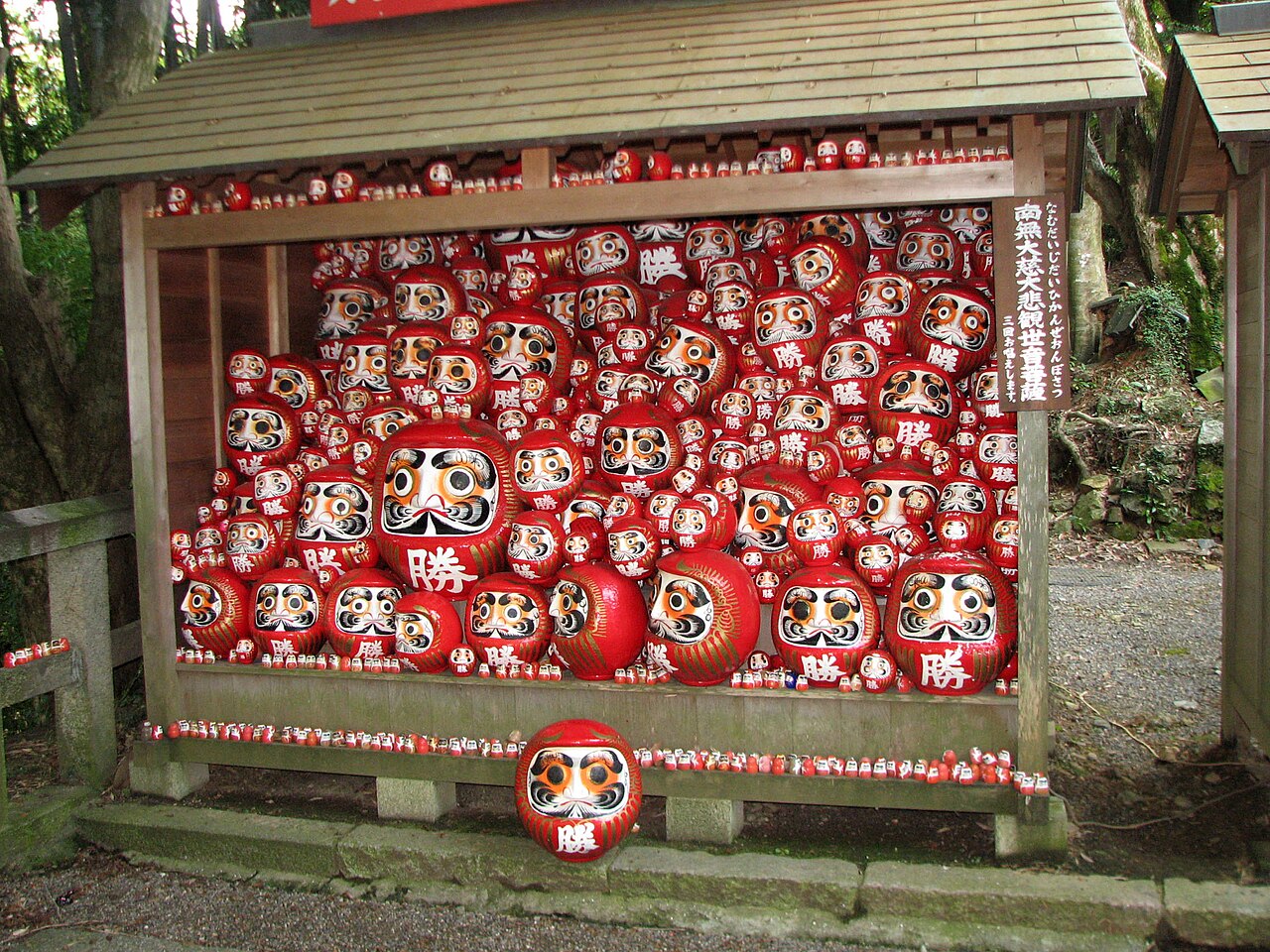
- The daruma everywherereturned dolls filling ledges, roots, handrails, wall cavities and lantern bases across the whole compound — thousands, in every size
- Pond and vermilion bridgethe entrance sequence crosses water on a red bridge into a valley that a mist system regularly fills
- Main hall and the pilgrimage stampthe 23rd station of the Saigoku Kannon circuit; pilgrims collect the temple's seal here, and the route above the hall is stairs
- The flowering calendarplanted for a long season — cherry in spring, hydrangea in early summer, maple in autumn, camellia through winter
How to actually get there
- Umeda → Minoh-Kayano Stn (Midosuji Line / Kita-Osaka Kyuko, ~25 min).
- Hankyu Bus from stand 8 to the Katsuoji stop (~20 min) — check the return timetable before entering.
- Cross the vermilion bridge, climb the stairways past the daruma ledges to the main hall, then loop back down the far path.
- Umeda → Minoh-Kayano → Hankyu bus to Katsuoji
- Umeda →(Osaka Metro Midosuji Line, running through onto the Kita-Osaka Kyuko line, ~25 min)→ Minoh-Kayano Stn → Hankyu Bus from stand 8, bound for Katsuoji, alight at the Katsuoji stop (~20 min). The temple gate is at the stop. Total about 60 minutes from Umeda. Buses are not frequent — check the timetable at the stand and note your return time before you walk in.
- Same bus back — check the last departure
- Return by Hankyu bus to Minoh-Kayano, then the Kita-Osaka Kyuko / Midosuji Line back into central Osaka. Services thin out in the late afternoon and stop well before evening; confirm the last bus at the stop when you arrive, because there is no practical alternative down the mountain.
About the place
Katsuo-ji sells daruma, which is unremarkable, and then something remarkable happens to them. The temple's speciality is katsu-daruma, 'winning daruma' — you buy one, name the thing you intend to win at, and take it home. When the thing is achieved you bring the doll back. Because visitors have been doing this for a very long time and the temple does not clear them away, the returned daruma have accumulated: they sit in ranks on stone ledges, wedged into tree roots, lined along handrails, tucked under lanterns, filling the gaps in walls, thousands of them, in every size, all facing outward with their painted eyes filled in. The effect on a first visit is genuinely strange — a Buddhist mountain temple slowly being occupied by small red figures. The setting does a lot of work too: the grounds run up a valley in the Minoh hills with a pond, a vermilion bridge and a mist system that fills the lower basin, and the planting is arranged for a long season — cherry, hydrangea, autumn maple, and camellia through winter.
How to enjoy it
The bus is the whole logistics problem. Check both the outbound and the last return departure before you leave the stand, allow two hours inside, and do not assume you can improvise a way down. Once inside, walk it as a loop rather than a straight line to the main hall — the daruma are densest along the side stairways and the return path, not on the main axis. If you buy one, the point is that you take it home and bring it back; the temple posts the practice in English. Weekday mornings are far quieter than weekends, and the mist in the lower basin is most photogenic in the first part of the day.
Background & history
The temple traces its origins to the 8th century and has stood in these hills for around 1,300 years. It is the 23rd stop on the Saigoku Kannon pilgrimage, the thirty-three-temple circuit through western Japan that has been walked since the Heian period, which is why it appears in Japanese pilgrimage records far earlier than in any tourist guide. The name is written with the characters for 'winning' — traditionally explained by an imperial connection in which the temple's prayers were credited with a victory — and the modern daruma custom grew directly out of that association. In recent years photographs of the massed daruma have circulated widely in overseas media, which has changed the visitor mix considerably without changing what the dolls actually are.
Before you go
- Cash
- Entry is 500 yen for adults (high school and above), 400 yen for elementary and junior high school students, and 100 yen for preschool children; under 2 free. Daruma are sold in a range of sizes from a few hundred yen upward. Bring cash — this is a mountain temple, not a museum. IC cards work on the metro and the Hankyu bus.
- Good to know
- Open 8:00-17:00 on weekdays, Sundays and public holidays, and 8:00-18:00 on Saturdays, with last entry 30 minutes before closing. The real constraint is the bus, not the gate: the service to and from Katsuoji is roughly hourly and finishes earlier than you would expect.
- Another way
- Hankyu Bus route 29 from Senri-Chuo Station reaches Katsuoji in about 35 minutes and is the other standard approach. Driving is straightforward and there is a paid car park at the temple, which is why many Japanese visitors come by car.
- After you get off
- The Katsuoji bus stop is directly at the temple entrance — cross to the ticket window and the vermilion bridge over the pond begins the route.
Nearby notes
 Otto Domes / CC BY-SA 4.0
Nature · Osaka★
Minoh River Dam & Visitor Center
1.4 km · straight line
 Kanchi1979 / CC BY-SA 4.0
Nature · Osaka★★★
Minoo Falls
2.2 km · straight line
 山中紘治 / CC BY 2.1 jp
Local life · Osaka★
Miyama-no-Sato & Ryusenkyo Gorge
6.1 km · straight line
 663highland / CC BY-SA 3.0
History · Osaka★
Tower of the Sun
7.5 km · straight line
Distances are straight lines on the map, not travel times.