Gunma · KusatsuNo.266★★★Open in map →
Kusatsu Onsen's Yubatake
— hot spring running through open wooden channels
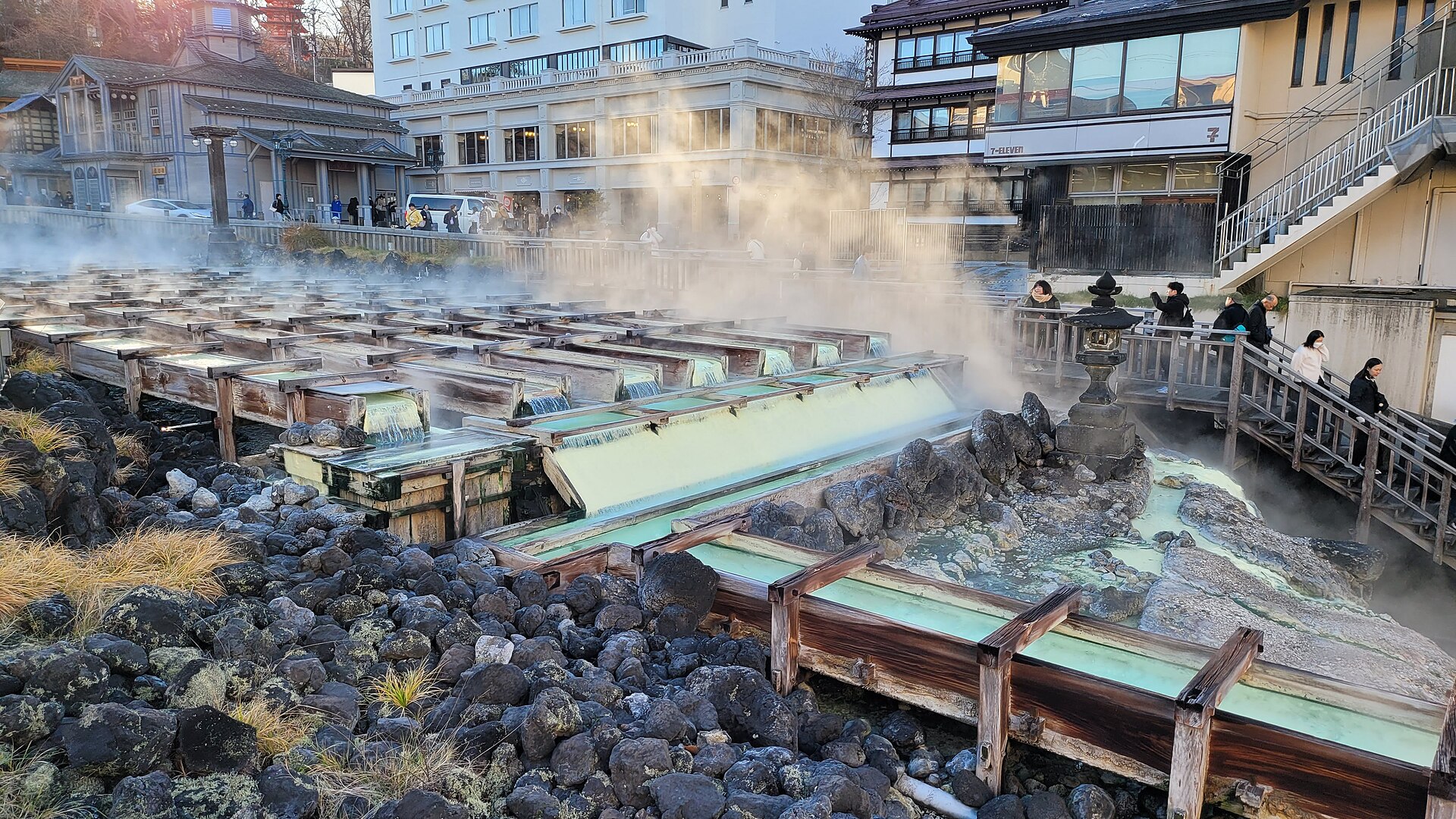
The steaming wooden field at the centre of Kusatsu, where about 4,000 litres of spring water a minute is cooled in seven open channels before being piped to the town's baths. Free, unenclosed, and lit after dark.
- FromUeno Stn
- ~2 hours 45 minlimited express + bus
- Get off atKusatsu Onsen Bus Terminal
- From there
- Kusatsu Onsen's Yubatake
Where it is
20 more notes in Gunma · open the map →What to look for — in walking order
- The seven conduitsopen wooden channels carrying about 4,000 litres a minute of pH 2.1 water straight down the middle of the town
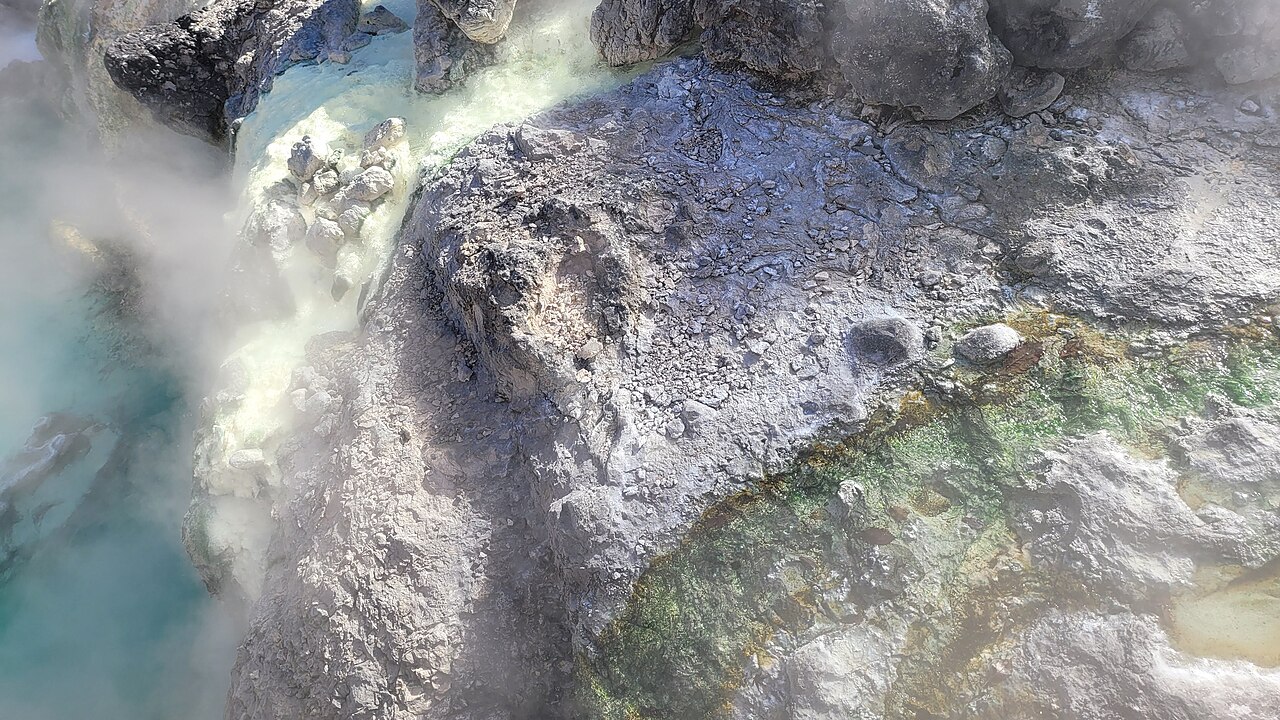
- Yunohana bedsminerals condense and settle inside the channels as the water cools, and the sediment is collected as yunohana bath flakes
- Yoshimune's stone pillara marker at the edge of the field for the spring water once drawn here and carried to the eighth shogun, Tokugawa Yoshimune
- Yumomi at Netsunoyudirectly beside the Yubatake, a team cools the water by hand with long wooden boards, singing and dancing in time
- Sainokawara Parkabout 12 minutes' walk away, a valley where hot water surfaces in the open, with a large outdoor bath at the far end
How to actually get there
- Ueno Station → Naganohara-Kusatsuguchi Station (JR limited express, ~2 hours 15 min).
- Naganohara-Kusatsuguchi Station → Kusatsu Onsen Bus Terminal (JR bus, ~25 min).
- Bus terminal → Yubatake (walk downhill, ~5 min).
- JR limited express from Ueno + JR bus
- Ueno Station →(JR limited express toward Naganohara-Kusatsuguchi, ~2 hours 15 min)→ Naganohara-Kusatsuguchi Station →(JR bus, ~25 min)→ Kusatsu Onsen Bus Terminal →(walk ~5 min downhill)→ Yubatake. Total journey about 2 hours 45 minutes. The bus meets the train, so the connection is short.
- Bus to Naganohara-Kusatsuguchi, then limited express to Ueno
- From Kusatsu Onsen Bus Terminal, JR bus to Naganohara-Kusatsuguchi Station (~25 min), then the limited express back to Ueno (~2 hours 15 min). Check the day's departures on the board at the terminal when you arrive — services thin out in the evening, and missing the last connection means staying the night.
About the place
Kusatsu produces the largest volume of naturally welling hot spring water of any resort in Japan, and the Yubatake — literally 'hot water field' — is where that volume becomes something you can stand next to. About 4,000 litres a minute surfaces here and runs through seven open wooden conduits laid across the middle of the town. The water leaves the source at around 55°C, far too hot to enter, and the journey through those conduits is what cools it before it reaches the inns and public baths around the square. As it flows, dissolved minerals condense and settle on the wood; the sediment is harvested as yunohana, hot spring flakes. The water is strongly acidic, at pH 2.1. Beside the field stands a stone pillar marking the spot where water was once drawn and carried to the eighth shogun, Tokugawa Yoshimune.
How to enjoy it
The Yubatake is outdoors, free and never closes, which makes it two different places depending on when you stand there. Come at first light and the steam is at its thickest against the cold air, with the square almost empty; come after dark and the field is lit, with the surrounding lanes at their busiest. Between the two, walk up to Sainokawara Park (about 12 minutes) for the open-air bath, and stop at Netsunoyu beside the field for the yumomi performance. Staying a night is the natural way to see both versions.
Background & history
Kusatsu's water has long been valued for its curative reputation, and the town's identity rests on the volume and strength of its springs rather than on any single famous bathhouse. Next to the Yubatake stand a stone pillar and old wooden frames marking the point from which hot water was drawn and sent to the eighth shogun, Tokugawa Yoshimune — a measure of how far word of these springs travelled in the Edo period. The problem the town has always had to solve is heat: water arriving at around 55°C cannot be entered, and diluting it would weaken what people come for. Kusatsu's answer was to cool the water without adding any, by exposing it to the air along the seven conduits of the Yubatake. Next door at Netsunoyu the same problem is solved by hand, with long wooden boards stirred through the water in time to a folk song. Kusatsu's modern reputation was fixed in the nineteenth century by the German physician Erwin Baelz, who studied the water and argued for it as a medical resource; a bust of him stands in the town. The same heat problem also produced jikan-yu, a timed communal immersion taken to a caller's count, still practised as part of the town's bathing culture.
Before you go
- Cash
- The Yubatake itself is free and open at all hours. Netsunoyu (for the yumomi performance) and the Sainokawara open-air bath are charged separately. Bring cash: this is a mountain town and not every bathhouse, food stall or souvenir shop takes cards.
- Good to know
- The Yubatake is outdoors and can be visited at any hour, including after dark when it is lit. The water is strongly acidic at pH 2.1 — which is exactly why it is cooled in the air rather than diluted — so take the usual care with metal jewellery and sensitive skin when bathing.
- Another way
- Direct highway buses run from Shinjuku, Shibuya and Tokyo stations to Kusatsu Onsen Bus Terminal in about four hours with no changes. By car it is roughly three hours from Tokyo.
- After you get off
- From Kusatsu Onsen Bus Terminal, walk downhill for about 5 minutes. The Yubatake occupies the open square at the centre of town, and the steam is visible before you reach it.
Nearby notes
 On-chan / CC0
Local life · Gunma★★
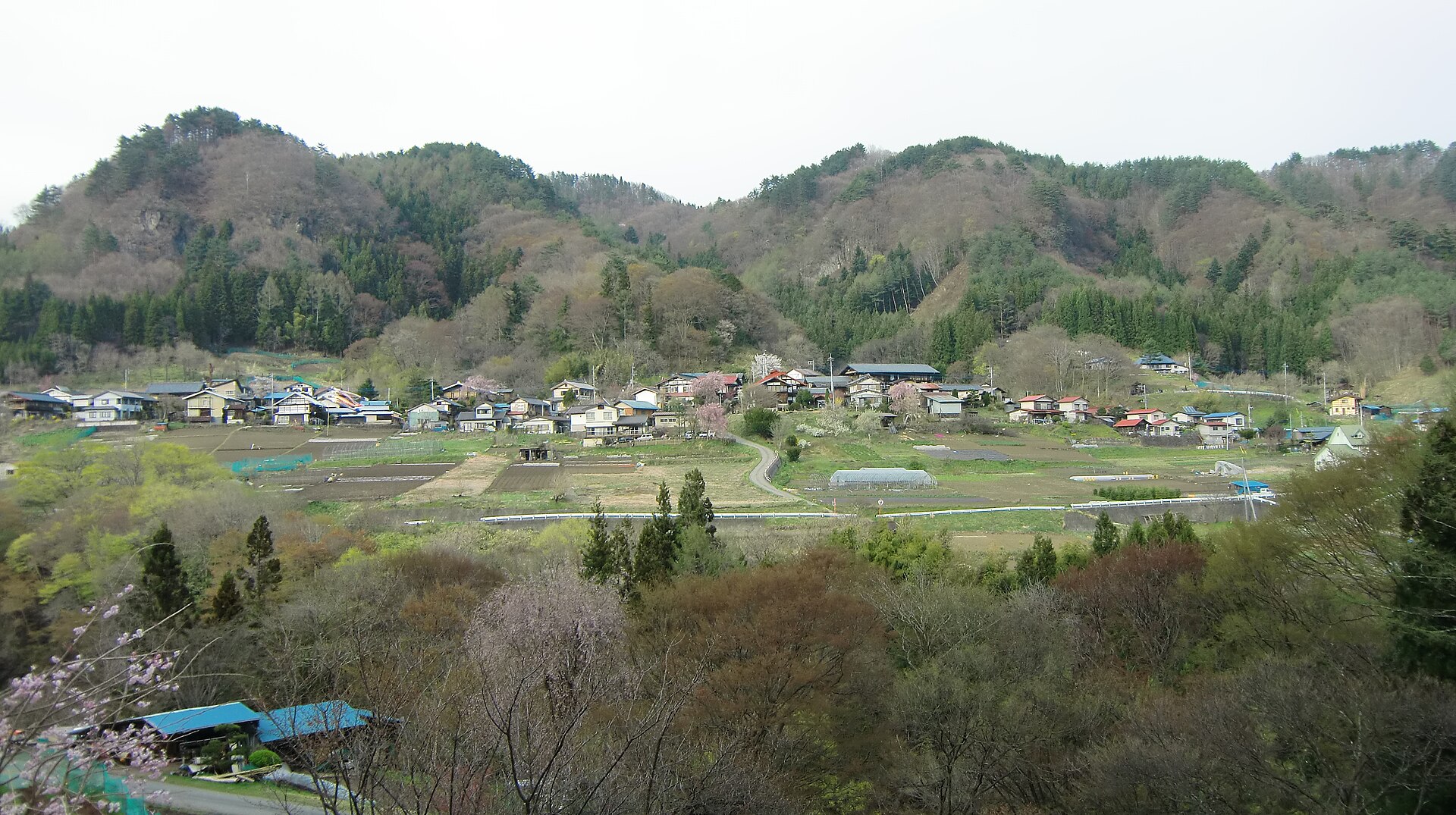
Kuni-Akaiwa Village
5.8 km · straight line
 koichi_hayakawa / CC BY 4.0
Nature · Nagano★★
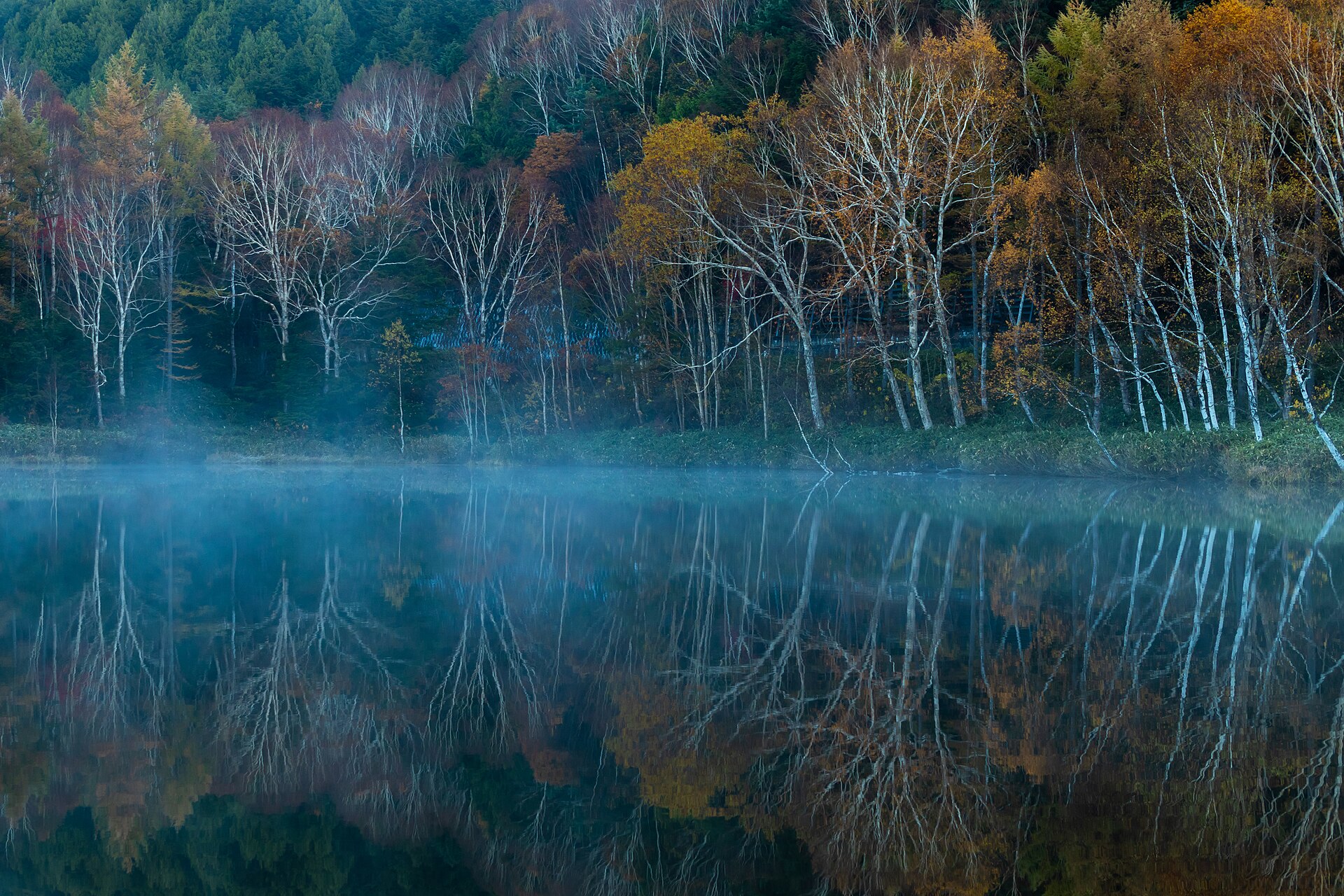
Shiga Kogen
14.3 km · straight line
 Ashley98lee / CC BY 4.0
Nature · Nagano★★★
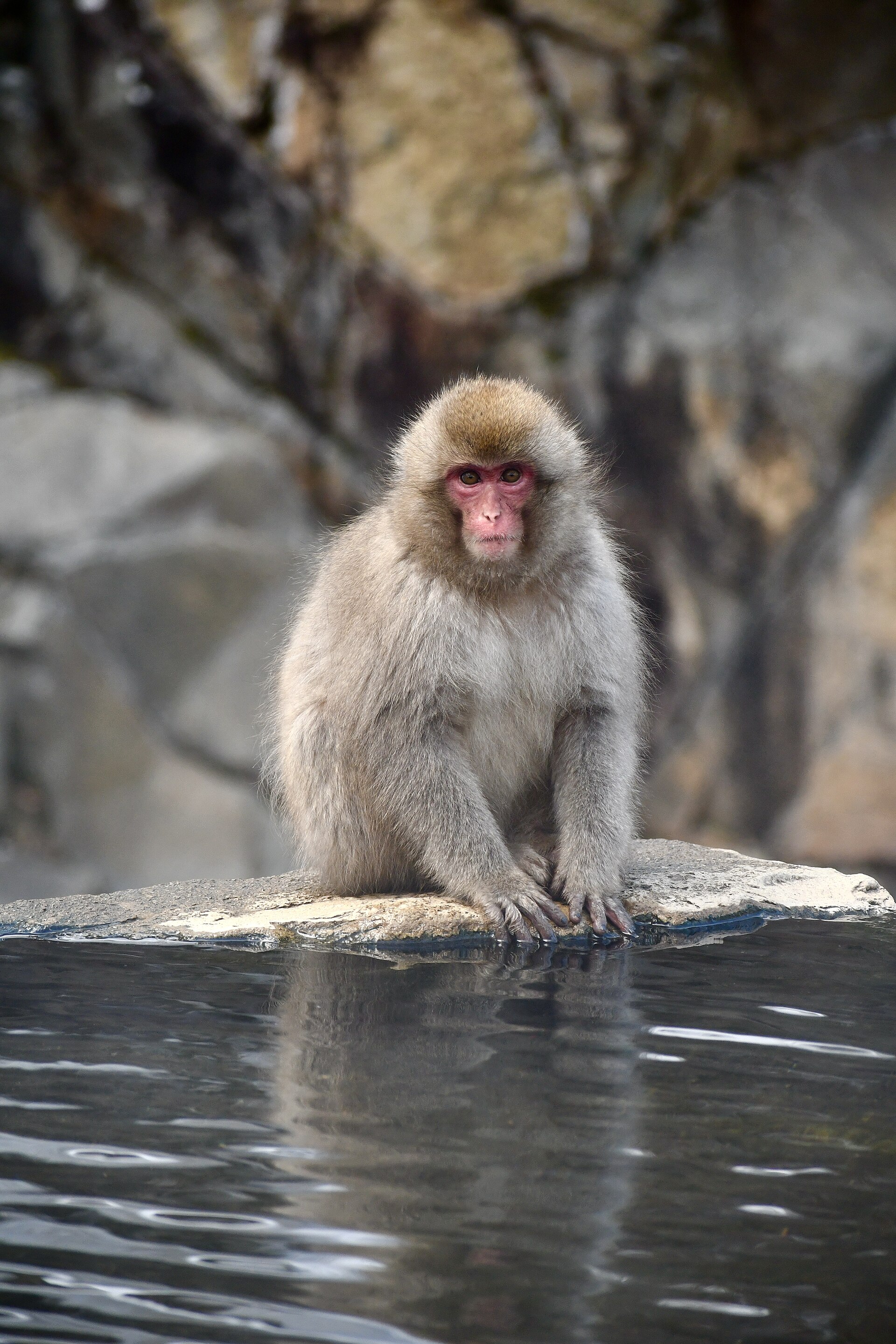
Jigokudani Monkey Park
17.1 km · straight line
 DJ Quietstorm / CC BY 2.0
Onsen · Gunma★
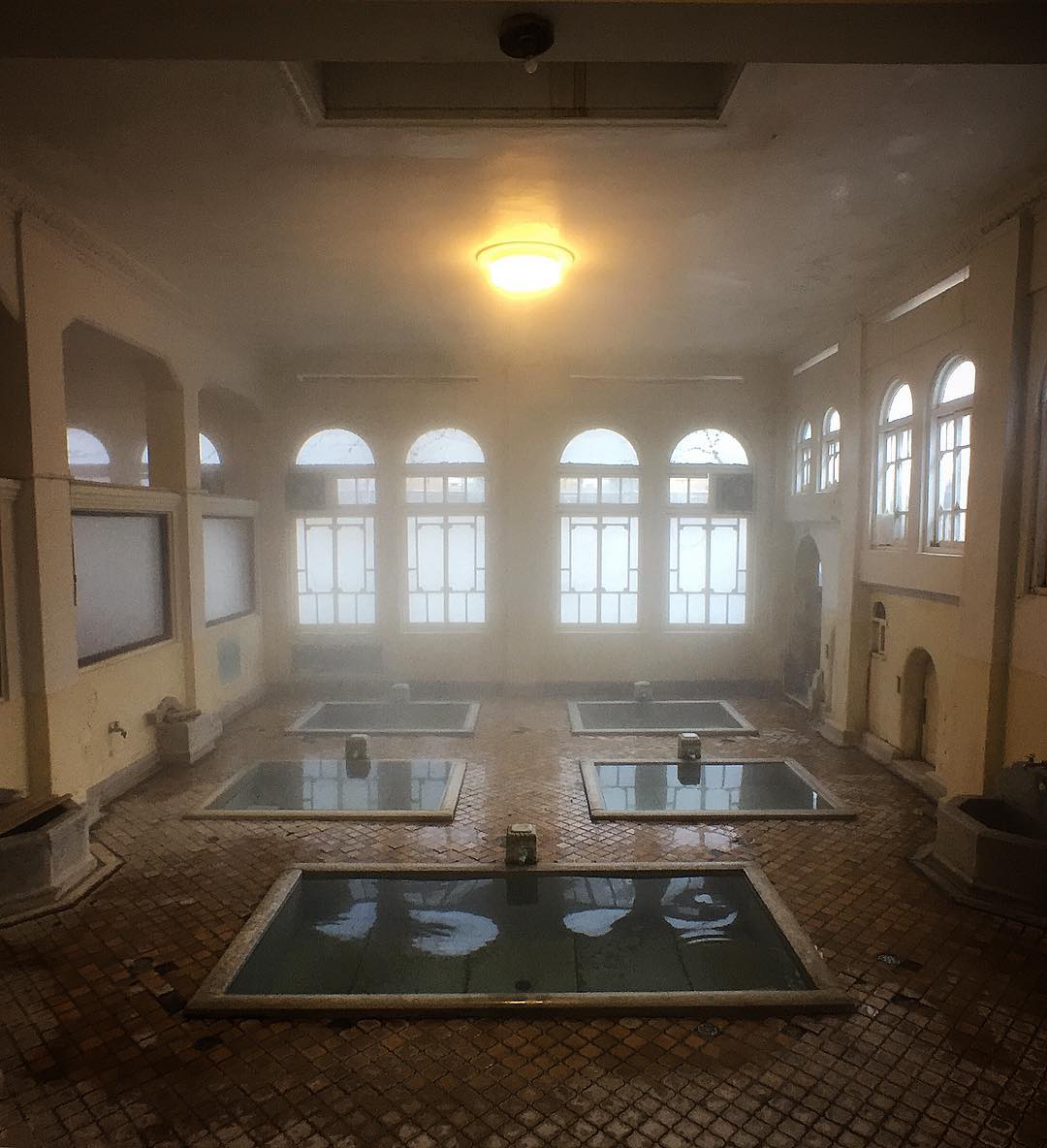
Shima Onsen
17.4 km · straight line
Distances are straight lines on the map, not travel times.